
Do you know what kind of resources can help you to expand your knowledge of a second language?
I’ve been looking for some examples on the internet to share with you and my students. While searching the internet I was surprised to come across something that I had already used when I was learning English – the visual dictionary.
In this post, I’ll tell you a little bit about what a Visual Dictionary is and what benefits it can provide for you and your Spanish learning.
What is a Spanish Visual Dictionary?
The definition is simple. A Visual Dictionary is a tool to find out the unknown meaning of certain words through images – visual stimulation. Specifically, a Spanish Visual Dictionary will help you to understand those words you are not familiar with and to memorise them in a meaningful way.

Visual dictionary vs. ordinary dictionary
In my opinion, both the visual dictionary and the ordinary dictionary are very useful tools when learning a new language.
The visual dictionary shows you the meanings of pictures, while the ordinary dictionary explains the meaning in words with a definition.
In addition, the visual dictionary can not only make use of simple images, but also diagrams, mind maps, graphs, icons, which can make it much easier to retain and understand the meaning of the words.
However, when we are looking for the meaning of more abstract words, for example, emotions or complex verbs, the explanation through words is of great help to understand the different shades of meaning.
Perhaps, the best visual dictionary in Spanish would be a combination of both dictionaries to get a more precise meaning of those words you don’t know. You could combine an image and a phrase as an example or add other aspects of the language such as synonyms, antonyms or phonetic transcription.
Is a Spanish visual dictionary for dummies?
Personally I would say that it depends on the dictionary and its functionality. There are very basic visual dictionaries, but others have a high level of specification.
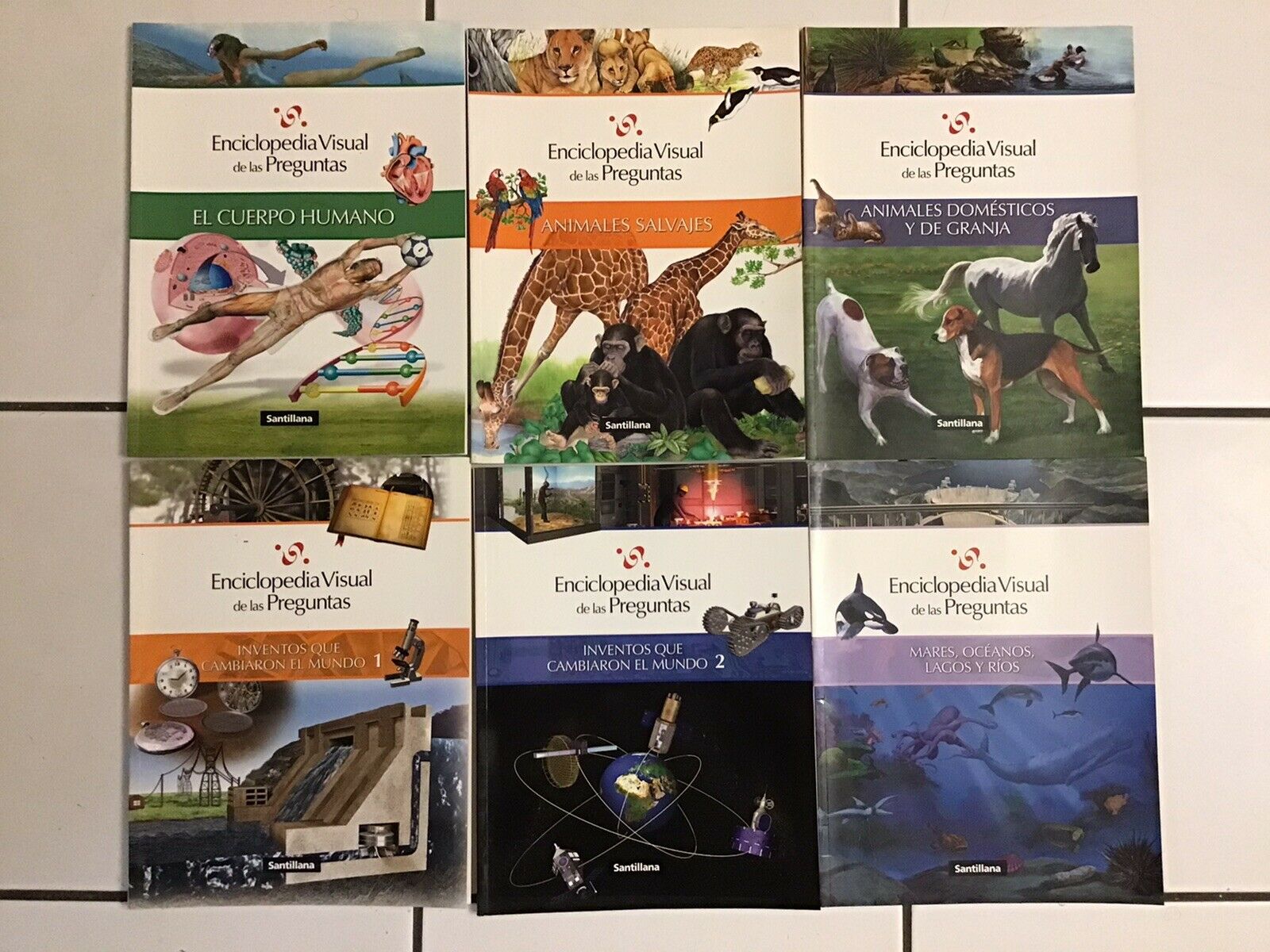
While looking for examples, I found visual encyclopedias which contain a wide variety of illustrated vocabulary and information.
Whether you need to do a specific project, or you want to know in more depth about a topic, here is an example of a visual encyclopedia organised in volumes that you might like:
What are the benefits of a visual dictionary when learning Spanish?
According to scientific articles I have consulted, images are more easily retained in our memory than words because our brain thinks in images. So if you are a visual learner and you are studying Spanish as a second language, this type of dictionary will be more effective for you, as the images will have a greater impact on your memory.

One of the things I like most about visual dictionaries is that they are organized into categories rather than alphabetically. This allows you to see words in context and associate them with other words and situations. Connecting words to situations makes it easier for us to memorise and learn them. When we are expanding the vocabulary of a second language, context plays a very important role.
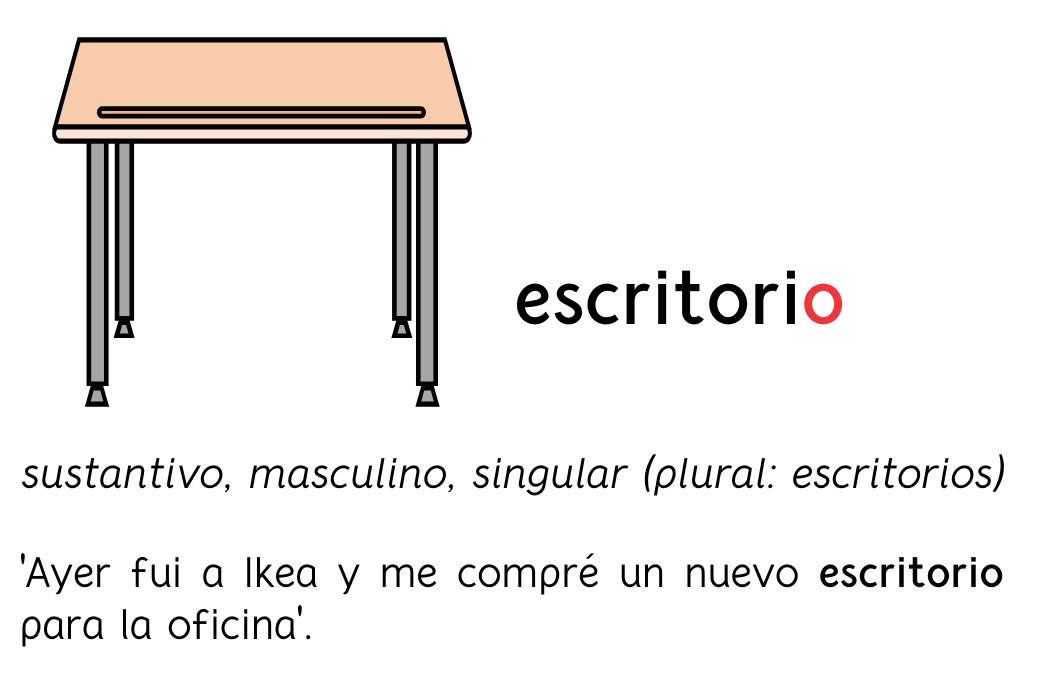
In addition, a picture does not have to be associated with a single word. For example, an image of a desk may have the word ‘desk’ associated with it, but in addition, all the different objects related to it: book, notebook, pen, pencil, rubber, table lamp, laptop, tablet… and all this vocabulary would be under the category of ‘study material’ or ‘in the office’.
Being able to organise words thematically and not just alphabetically helps our brain to establish groups and visualise more easily what we want to learn.

Types of Spanish visual dictionaries and examples
– Monolingual visual dictionaries: Dictionaries that offer the translation of the word in the target language only. Nowadays, they usually include an application/option to listen to the correct pronunciation.
– Multilingual visual dictionary: Some dictionaries offer the translation of a word in several different languages. Here is a specific example of a multilingual dictionary from the DK collection.
– Visual dictionary in app for your mobile: WordList Visual Learning is a free app to download to your phone and practice Spanish in a visual way.
How to create your own Spanish Visual Dictionary
I advise you to create your own visual dictionary when you study (collages, sketches, notes etc).
If you are a bit creative and like to draw, why not create your own visual ‘dictionary’? Putting things into practice is the most effective way to learn.
This is something I did when I was learning English and, besides being a relaxing activity, it was a good practice for my memory to understand and learn the meaning of new words. I did it in a rudimentary way: magazines, scissors, glue, cardboard and some drawings of mine. One of the examples I created was about kitchen utensils. This was useful for me as I had just started working in a restaurant and I didn’t know much of the vocabulary.
This below could be another example. In this case, the category or topic is ‘Meal times in Spain”, divided into three subcategories: time/hours and then the foods and its labels.

If you don’t want to draw it yourself, you could use the Canva tool to make it in digital mode (I used it for the desktop example).
Don’t know how? Watch this short video:
My Spanish visual dictionary: A Visual Guide for surviving your first experience in Spain + FREE DOWNLOADABLE PDF
How can you use a Spanish visual dictionary in your daily life?
Personally I think that, for a learning material/resources to be useful, it needs to solve a real problem that you have as a student of Spanish. Maybe a picture of the Spanish fauna (animals) with the names of the different animals is not very useful for you if you live and work/study in Spain, since you will probably never need to use that vocabulary.

Therefore, I am working on a visual dictionary called ‘A Visual Guide for surviving your first experience in Spain in which vocabulary is explored and connected to the situations and contexts that you as a student are going to experience day to day.
Here are some examples so you can see what I mean:


If you liked those infographics, you can download HERE my FREE pdf to get the complete Spanish visual guide for surviving your first experience in Spain.