Why can’t I improve my Spanish reading skills?
As you know, learning a language requires the command of several skills, four to be precise, and reading comprehension is one of those skills and one of the most difficult for Spanish students like you. I’m not just talking about being able to read and understand the gist of a text, we can all do that (or almost all of us). For example, when you take a DELE or Cambridge exam (if you study English), the reading task is extremely difficult. Time is against you, you barely have time to think about the correct answer, let alone reread the text. You have to master this skill very well, you have to be able to read quickly, extract main themes and minute details, relate information… In short, you need a lot of practice, and you need to read a lot in the target language.
But why do you find it so hard to read in a foreign language? Because you are not choosing the right material. Today I want to convince you to change your novels or ordinary books for another resource, the comic. I want to make you realize that it’s a better option. Read on…
What is ‘comic’ in Spanish?
How to say ‘comic’ in Spanish? There are different translations: cómic (same as English but with an accent on the ‘o’), historieta, tira cómica, tebeo o novela gráfica. Perhaps, the most common way is cómic (the way I prefer to say it).

Today I want to tell you a few interesting facts about comics and why I think they are very useful for learning Spanish.
In my opinion, comic is the best resource for you to practice your reading and comprehension skills. It is a better option than ordinary books or novels. These are my reasons:
- It tells you a story in an entertaining, fun, and playful way. It makes the assimilation of vocabulary, grammar, and cultural aspects easier for you.
- Comics are very visual. The connection between the image and the text makes it easier for you to understand the story.
- Comics bring color to the classroom and catch your attention to awaken your curiosity.
- They keep you attentive and motivated while you read thanks to the colors and drawings.
- You can have a better picture of the characters and setting of the story thanks to the illustrations.
- Comics foster your creativity.
- There are different sizes of comics. From one full book to a simple page. You can pick depending on your abilities.
- Comics reflect values of Hispanic culture and society. So you will also learn about these aspects.
- It represents different levels and models of language: hesitations, interrupted sentences, reproduction of sounds, substitution of words for signs, short sentences, etc.
- The language of the comic is of an informal register, of everyday life, of dialogue between friends and acquaintances.
Elements of a comic
We can talk about two categories: One related to the text and words (bocadillos o globos de texto, diálogo y cartela y onomatopeyas), and another related to the pictures and drawings (viñeta, tira cómica, dibujos y personajes).
I explain it more visually in the following picture:


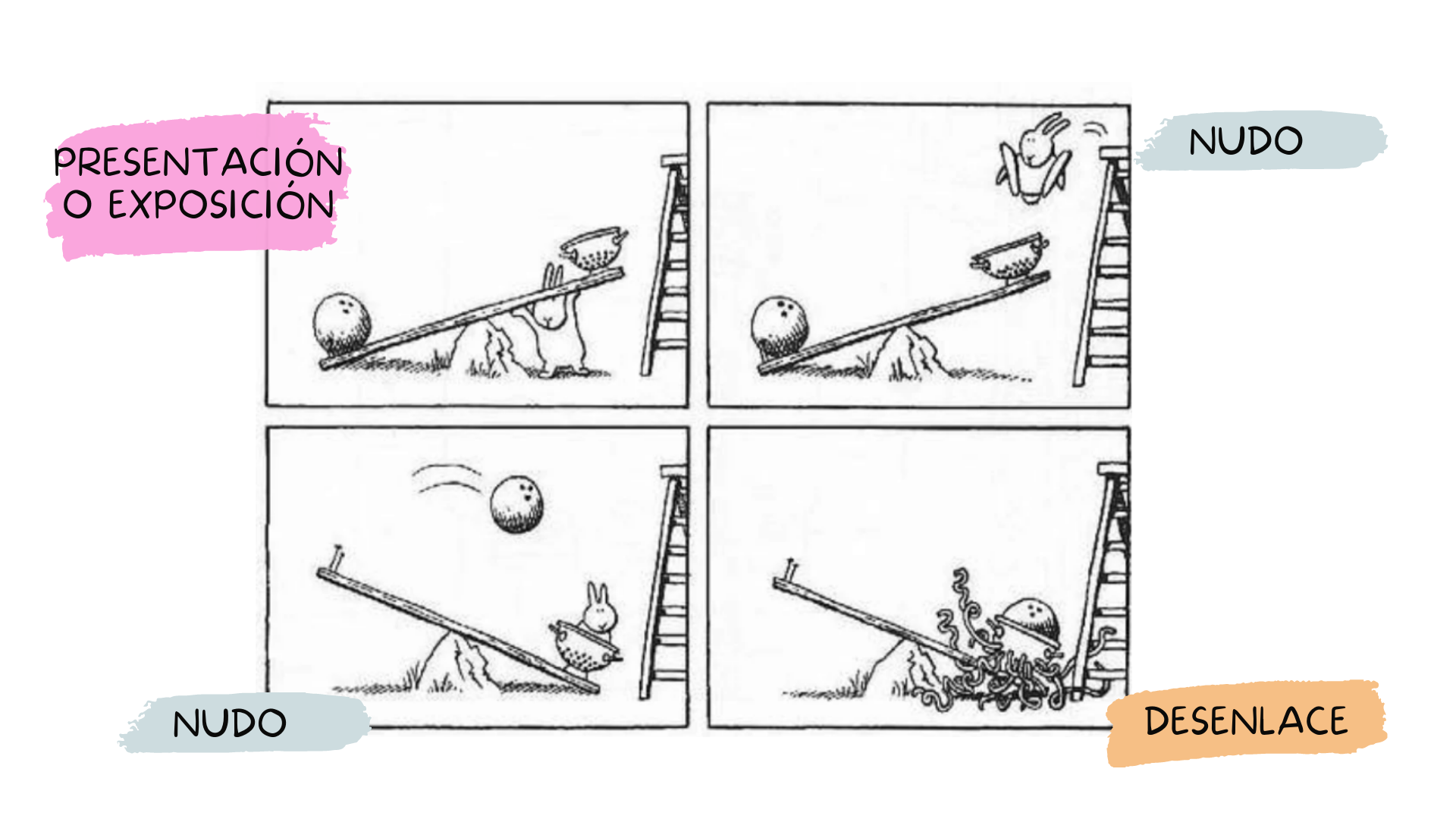
A comic strip structure
The comic is formed by ‘viñetas’. Actions are represented in the ‘viñetas’ by drawings that make the story move forward. Regardless of the length of the story told, it consists of an introduction (introducción/presentación/exposición), middle/plot (nudo) and ending (desenlace).
INTRODUCTION: You get to know the characters and the context of the story.
MIDDLE/PLOT: What happens after the beginning. Events are told and a problem (more or less serious) is presented.
ENDING: The end of the story. The problem is solved, or a conclusion is reached. It is usually the last vignette, especially in short comic strips.
The oldest comic in the world
People have been writing illustrated comics since 1800. Very similar to the ones we read nowadays. The first comic strip appeared in 1895 in New York, with its main character called THE YELLOW KID, a young man dressed in a yellow nightgown, with a bald head and his front teeth separated.

In Spain, the first comic strips appeared in the magazine ‘TBO’. Some of the most popular Spanish comics were:

Comics to learn Spanish
Did you know that comic strips are very popular in Spain among teenagers and adults? Many people prefer to read comics more than novels or ordinary books because they are very entertaining, fun, and easy to read. In addition to those Spanish comics that I mentioned above, I would like to add some different comic books that you could use to practice your reading skills and expand your vocabulary.
- Comics in Spanish:
❤ Garfield by Jim Davis (U.S)
❤ Pearls before swine by Stephan Pastis (U.S)
❤ Snoopy by Charles Schulz (U.S)
❤ The Adventures of Tintin by Hergé (France)

- Latinoamerican cartoonists:
❤ Mafalda by Quino (Argentina)
❤ La Volátil by Agustina Herrero (Argenina)
❤ Mujeres Alteradas by Maitena (Argentina)
❤ Gaturro by NIK (Argentina)
❤ Condorito by René Ríos (Chile)
❤ Macanudo by Liniers (Buenos Aires)

- Spanish cartoonist:
❤ MonstruosaMente by Alfonso Casas (Zaragoza)
❤ Lola Vendetta by Raquel Ribas Rossy (Barcelona)
❤ Moderna de Pueblo by Raquel Córcoles (Tarragona)
❤ Mortadelo y Filemón by Francisco Ibáñez (Barcelona)
❤ 72kilos by Oscar Alonso (Bilbao)

Give it a go!
If you want to know more about visual learning, visual thinking and its benefits when learning a second language, check out my previous posts!
THANK YOU FOR READING!